


WE TREAT
Ankle Sprains Assessment and Treatment in Leeds
From mild sprains to more severe injuries, we provide personalised care to support your recovery.


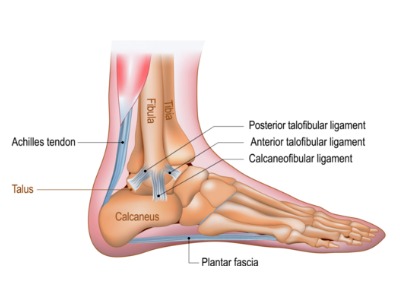
At Foot Pain Centres of Leeds, our assessment focuses on determining the severity of the injury and identifying which ligaments may be involved. We also evaluate ankle stability, joint mobility, foot posture, and your walking pattern to understand any underlying factors that may increase the risk of injury or delayed recovery.
Our goal is to restore normal movement, eliminate pain, provide a structured plan for a safe return to sport or daily activity, and reduce the risk of future sprains.
Recognising the Symptoms of an Inversion Sprain
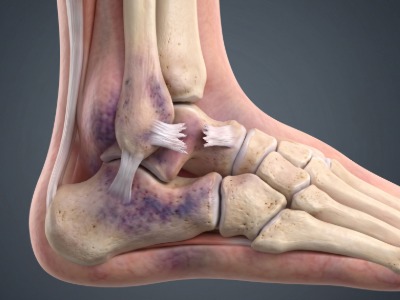
An ankle sprain or strain typically occurs when the foot is forcibly turned inwards or outwards. The more common injury is when your foot is turned inwards, known as an inversion sprain. This action stresses the ligaments on the outer side of the ankle, often resulting in a strain/sprain, which can lead to a partial tear or full rupture of the ligaments. If you have sustained an inversion injury, you will likely experience immediate symptoms in the foot and ankle, such as:
- Acute Pain: Sharp discomfort at the time of injury.
- Swelling: Rapid inflammation around the joint.
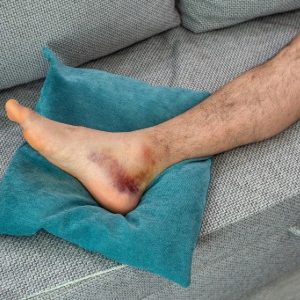
- Bruising: Discolouration as a result of tissue damage.
- Stiffness: Significant loss of mobility and range of motion.
Podiatric Assessment of an Inversion Sprain
To identify the specific ligaments involved and the severity of the injury.
Analysis
- Ankle, joint mobility, and ligament power testing.
- Foot posture and alignment.
- Gait analysis
Action
- Reducing pain and swelling.
- Restoring normal movement.
- Improving ankle stability.
Treatment
- Joint mobilisation.
- Rehabilitation exercises.
- Supportive taping or bracing.

Immediate First Aid: The First 24–36 Hours
Taking swift action in the “acute phase” can significantly accelerate your recovery time. We recommend the following steps:
Ice and Compression
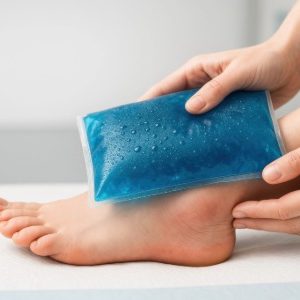
Using an ice pack (or a bag of frozen vegetables) wrapped in a thin towel over the injured area, apply a tie around the foot and ice pack, which should be secured on the top of your foot to provide essential compression. Repeat for 15-20 minutes every hour until the swelling begins to subside.
Elevation and Active Recovery
Keep the ankle elevated while resting and maintain joint mobility by performing small circular movements or “drawing” the lowercase alphabet with your toes.
Ankle Strapping
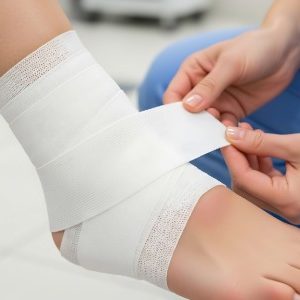
To help support your ankle, use an elasticated crepe bandage and figure-of-eight strapping or an elasticated ankle support.

Pain Management
Use over-the-counter pain relief in combination with anti-inflammatory medication. Ensure you strictly follow the dosage instructions on the packaging.
It is vital to consult a professional within the first 24 to 36 hours to rule out any possible fractures or high-grade ligament tears.
At Foot Pain Centres of Leeds, if required, we can provide access for X-ray examination, ultrasound or MRI scanning.
Seek Professional Advice
Managing Chronic Ankle Pain and Stability
If your ankle remains stiff, painful, or feels “unstable” several weeks post-injury, you may have developed restrictive scar tissue or a partial tear. Without intervention, this can lead to chronic instability.
Our advanced treatment for persistent sprains includes:
- Manual Therapy: Localised friction massage to break down internal scar tissue.
- Functional Rehabilitation: Progressive exercises to restore strength and proprioception (balance).
- Custom Orthotics: Bespoke insoles designed to realign the ankle joint and prevent future “giving way”.
Before and after the fitting of corrective custom Orthotics
Video shows the right ankle overloading on the outside
Video shows total correction of the right ankle joint using orthotics